Direct printing on rigid materials like glass, metal, and wood often requires complex pre-coatings and long drying times, leading to production delays and high rejection rates. A **uv printer** with flatbed technology eliminates these steps by using instant LED curing.
**UV flatbed printers enable direct printing on rigid materials by using UV-LED lamps to instantly cure specialized inks as they are deposited. This process, handled by a professional uv printer, allows for high-resolution, embossed, and scratch-resistant results on glass, acrylic, metal, and plastic without the need for pre-treatment, saving time and significantly increasing industrial production efficiency.**
Explore the technical features and diverse industrial applications of high-precision UV flatbed printing systems.
### What are UV DTF Transfers?
*(Note: Content refers to UV Flatbed process)*
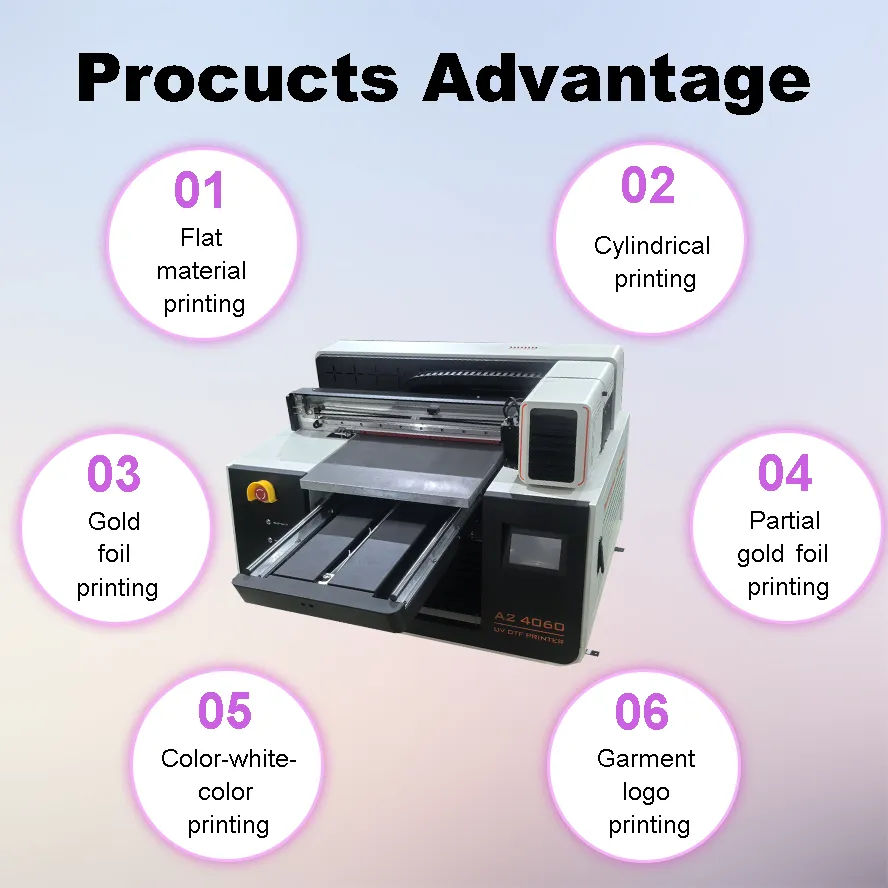
While UV DTF uses a transfer film, the **uv printer** (flatbed) prints directly onto the substrate. The machine features a flat vacuum table where materials like **acrylic printer** sheets or **glass printer** panels are secured. As the carriage moves, the printhead deposits CMYK, white, and varnish inks. ZUNSUNJET’s **UV flatbed printer** series, such as the 2513 model, supports up to 2400 DPI resolution. The **pvc printer** functionality is powered by industrial heads like the Ricoh Gen6, ensuring that the **impresora UV** can handle heavy-duty industrial materials with precision and speed.
### Why Choose UV DTF Transfers for Your Printing Projects?
*(Note: Content refers to UV Flatbed)*
Choosing a **uv printer** for industrial projects is ideal because it eliminates the need for screen making or film transfers. The **uv inkjet label printer** capability of a flatbed allows for direct-to-object branding on electronic casings, control panels, and machine parts. Furthermore, the **uv printer** supports a “white ink” layer, which is essential for printing vibrant colors on dark or transparent materials like **glass printer** panels or **wood printer** slabs. The ability to add a varnish layer also enables 3D embossed textures, providing a premium tactile feel that increases the market value of the finished product.
### Materials Needed for UV Flatbed Printing
A professional setup requires a high-performance **uv printer** and UV-curable inks. Unlike the **uv dtf machine**, no transfer films are needed. Essential materials include the rigid substrates themselves—such as **Acrylic**, **Wood**, **Glass**, **Metal**, and **PVC**. For certain smooth materials, a UV primer may be used to enhance adhesion. ZUNSUNJET’s **uv flatbed printer** kits include advanced RIP software like **Hoson or RIIN** to manage layering and color. Maintenance tools, including specialized cleaning fluids and lint-free wipes, are also necessary to protect the high-value printheads of the **imprimante UV**.
### Step-by-Step Guide to Making UV Flatbed Prints
The process begins by placing the rigid material on the **uv printer**’s vacuum table. The operator uses a visual positioning system to align the design. After setting the printhead height—often automated in ZUNSUNJET’s **glass printing machine** models—the print cycle begins. The **pvc printer** deposits ink and varnish, which are instantly cured by UV-LED lamps. For a 3D effect, multiple layers of white ink are applied first. Once the cycle is complete, the item can be handled immediately, as the **impresora UV** output is smudge-proof and ready for the next production stage.
### Common Challenges in UV Flatbed Printing and How to Overcome Them
A frequent challenge is “ink chipping” on smooth surfaces like glass or metal. This is overcome by using a high-quality UV primer or adjusting the **uv printer**’s lamp intensity. Another issue is nozzle clogging due to UV light reflection; ZUNSUNJET’s **uv flatbed printer** models feature shielded printhead carriages to prevent this. Furthermore, maintaining a dust-free environment is critical for an **imprimante UV**, as debris on the substrate can cause “firing” artifacts. Regular maintenance of the vacuum system ensures that the **acrylic printing machine** keeps materials perfectly flat, avoiding head strikes during high-speed runs.
### Where to Use UV Flatbed Prints?
UV flatbed printing is essential for the **Advertising & Signage** and **Industrial Manufacturing** industries. It is the primary tool for producing **acrylic signs**, **metal plaques**, and **PVC boards**. In the home décor market, it is used for **custom tiles**, **glass doors**, and **furniture panels**. Furthermore, the **uv printer** is used for **phone case printer**, **pen printer**, and **bottle printer** applications in the gift customization sector. ZUNSUNJET’s large-format **2513 UV flatbed printer** is deployed globally for heavy-duty industrial tasks, including printing on **electronic panels** and **machine casings** for distributors in American and European markets.
UV flatbed printers provide a powerful, direct-to-substrate solution for high-quality, durable, and textured printing across a vast array of industrial materials.